
Forklifts & Attachments
Technical Analysis: Axle Load Distribution, Residual Capacity and Safety When Unloading Vehicles from Containers with a Forklift Cradle
How much weight the cradle really carries, how the forklift must be sized, and which operating risks demand a procedure.
Application & Hydraulic Engineering
INCOFORK Technical Department
Abstract
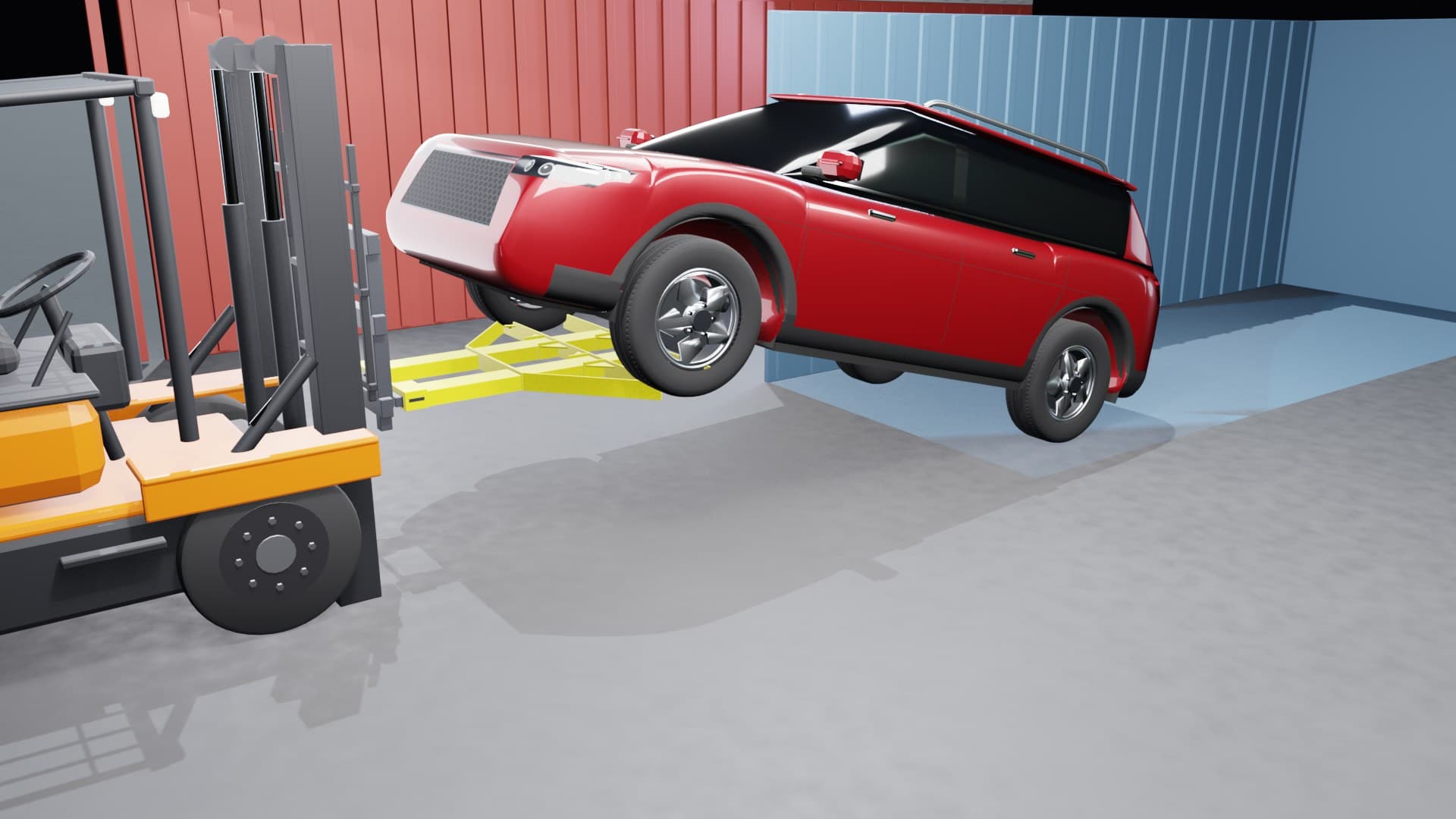
This study analyzes the unloading cradle, an attachment that supports a vehicle's front wheels and pulls it out of a shipping container with the forklift forks while the rear wheels roll on the floor. It quantifies the share of vehicle weight carried by the cradle from static axle distribution, estimates the forklift rated capacity required by the tipping-moment criterion, discusses the container's geometric constraints (usable width, height and floor strength), and covers procedure requirements under NR-11 and NR-12.
Table of Contents
1. Introduction: Getting a Vehicle Out of a Narrow Container
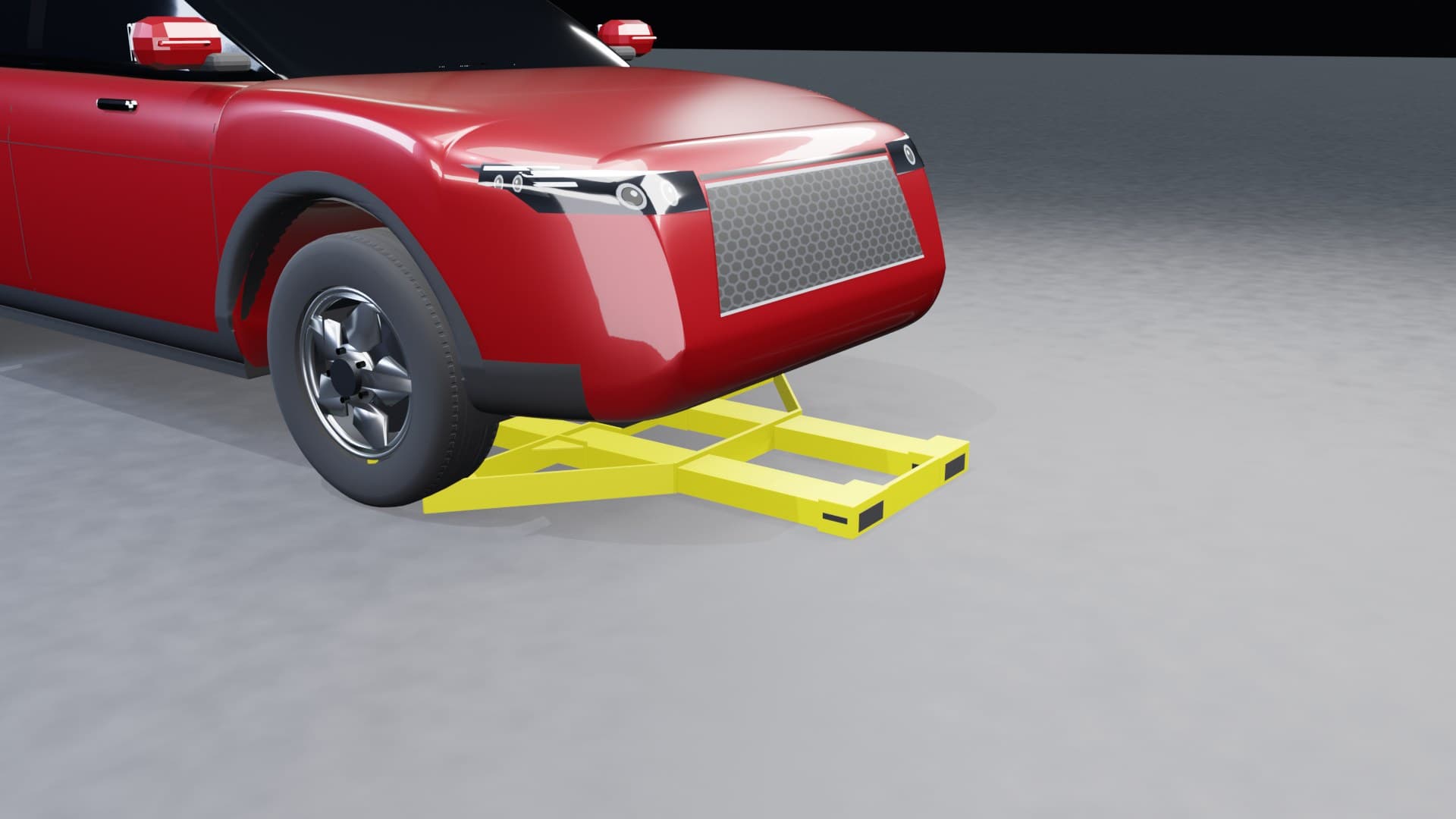
Vehicles imported in shipping containers have to come out through a narrow opening with little headroom, where winches and platforms do not always fit. The INCOFORK Vehicle Unloading Cradle solves it with a steel structure in which the front wheels seat in a channel between two crossbars. The forklift enters the cradle's two fork tubes, lifts the front of the vehicle and pulls it out, while the rear wheels roll on the floor.
The welded structure has 1,600 and 1,420 mm crossbars that serve as stops, diagonals and gussets that lock the assembly, and rectangular fork tubes with a 49 mm-high opening. This study shows how much weight the assembly really carries and how to size the forklift.
2. How Much Weight Is on the Cradle: Axle Distribution
The cradle supports only the front wheels. The share of vehicle weight on the front axle depends on the center of gravity position relative to the wheelbase. By static moment equilibrium about the rear axle, the front axle load is:
Front Axle Load
3. Sizing the Forklift by Load Center
The load center is the point where the load acts relative to the fork face. On the cradle it corresponds roughly to the front wheel axis, and a reasonable estimate for the cradle's 1,300 mm length is c ≈ 650 mm.
The minimum plate rated capacity of the forklift, at a 500 mm load center, can be estimated by equating moments: Q ≥ Wf · c / c₀.
Estimate of Required Rated Capacity (c = 650 mm; c₀ = 500 mm)
Add the cradle's own weight and a safety margin. In practice, 2.5-ton forklifts comfortably handle passenger cars and SUVs. Cradle capacity is provided on request, according to the vehicle.
4. Container Geometric Constraints
A standard 20 or 40-foot shipping container has a door opening of about 2.34 m wide by 2.28 m high and an interior width of around 2.35 m. This imposes three checks:
The channel between the crossbars is 322 mm, which accommodates wider passenger tires (around 255 mm section width) with room to seat.
Resulting Tilt
Raising the front by 150 mm over a 2.5 m wheelbase tilts the vehicle by arctan(0.15 / 2.5) ≈ 3.4°. It is a small angle, but enough for the car to roll on its own if speed is not controlled.
5. Procedure and Risks: NR-11 and NR-12
The operation combines a forklift, a loose load and a confined space. NR-11 covers materials handling, and NR-12 covers guarding and safety conditions of the attachment. Critical procedure points are:
Warning
The vehicle comes out with no braking on the rear wheels. Plan the exit path, the floor and the speed before starting the unload.
6. Technical Conclusion
The unloading cradle lets you take vehicles out of containers with an ordinary forklift, with no winches or ramps. The engineering of the operation comes down to three simple calculations: the share of weight on the front axle, the forklift's residual capacity at the cradle's load center, and the container's geometric clearances. With those settled, the operating procedure does the rest.
To size the cradle and forklift for the vehicles in your operation, talk to our engineering team.
Frequently Asked Questions (FAQ)
Engineering technical answers regarding kinematics, hydraulic circuits, NR-12/NR-10 safety and shop floor integration.
1How much weight does the unloading cradle support?
Capacity is defined on request, according to the vehicle. The cradle carries only the share of weight on the front axle, generally 55% to 62% of the vehicle weight.
2Which forklift do I need to use the cradle?
For passenger cars and SUVs, a 2.5-ton rated forklift usually has ample margin, provided it fits under the container door height. Do the load-center calculation and confirm with the manufacturer.
3Does the tire fit in the cradle channel?
The channel is 322 mm wide between the crossbars, which accommodates passenger and common SUV tires with room to seat.
4Can I unload a vehicle with no engine or drive?
Yes. Because the rear wheels roll freely on the floor, the vehicle does not need to run. This is one of the cradle's typical uses.
References & Standards
- BRAZIL. Ministry of Labor and Employment. Regulatory Standard No. 11 (NR-11): Transport, Movement, Storage and Handling of Materials. Brasília: MTE.
- BRAZIL. Ministry of Labor and Employment. Regulatory Standard No. 12 (NR-12): Safety in Machinery and Equipment. Brasília: MTE.
- INTERNATIONAL ORGANIZATION FOR STANDARDIZATION. ISO 1496-1: Series 1 freight containers — Specification and testing — Part 1: General cargo containers for general purposes. Geneva: ISO.
- INTERNATIONAL ORGANIZATION FOR STANDARDIZATION. ISO 3691-1: Industrial trucks — Safety requirements and verification. Geneva: ISO.
- GILLESPIE, T. D. Fundamentals of Vehicle Dynamics. Warrendale: SAE International.
Related Equipment
Vehicle Unloading Cradle
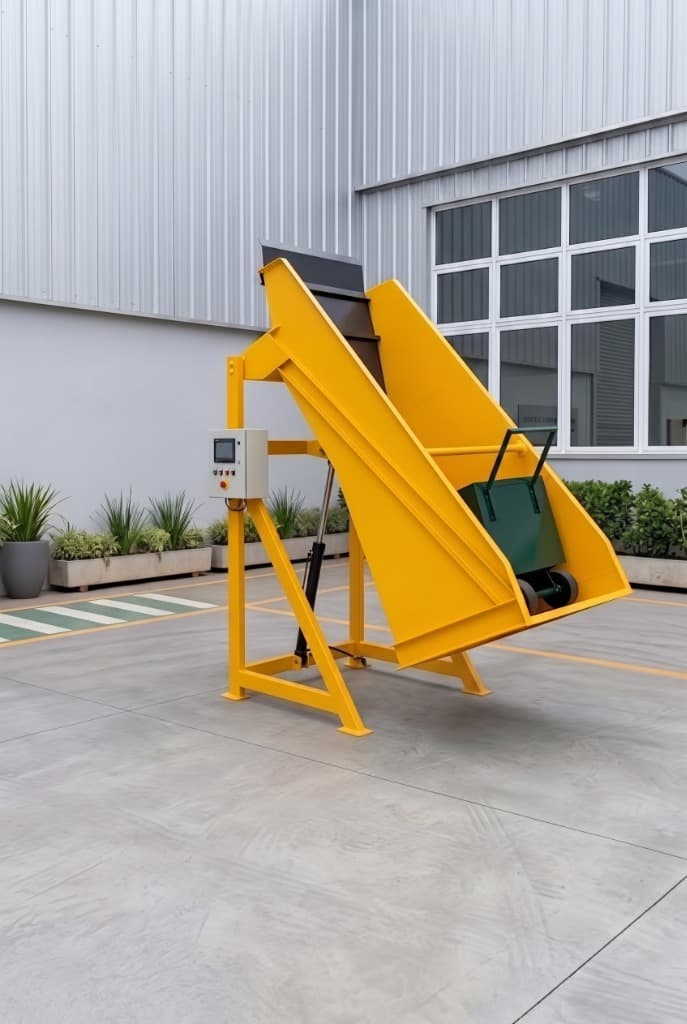
Autonomous station with 1.5 HP electro-hydraulic power unit, high-pressure cylinder (100 bar) with deceleration dampening via 3/8" valve, 135° tipping cradle, and full NR-10/NR-12 compliance.