
Forklifts & Attachments
Technical Analysis: Material Density, Rated Volume and Real Capacity of a Hydraulic Forklift Bucket
How much a bucket full of sand, gravel, grain or rubble weighs, and why volume (not rated load) is usually the practical limit.
Application & Hydraulic Engineering
INCOFORK Technical Department
Abstract
This study crosses the FK-0250 hydraulic bucket's rated volume (250 liters) with the bulk density of the most common materials in construction, agribusiness and industry to estimate mass per scoop. It shows that, for loose bulk materials, the practical limit is volume and forklift stability, not the attachment's 1,000 kg rated load. It discusses the 65° dump angle against the angle of repose, double-acting cylinder operation on the auxiliary valve, and the effect of the shifted center of gravity on the truck's residual capacity.
Table of Contents
1. Introduction: The Forklift as a Wheel Loader
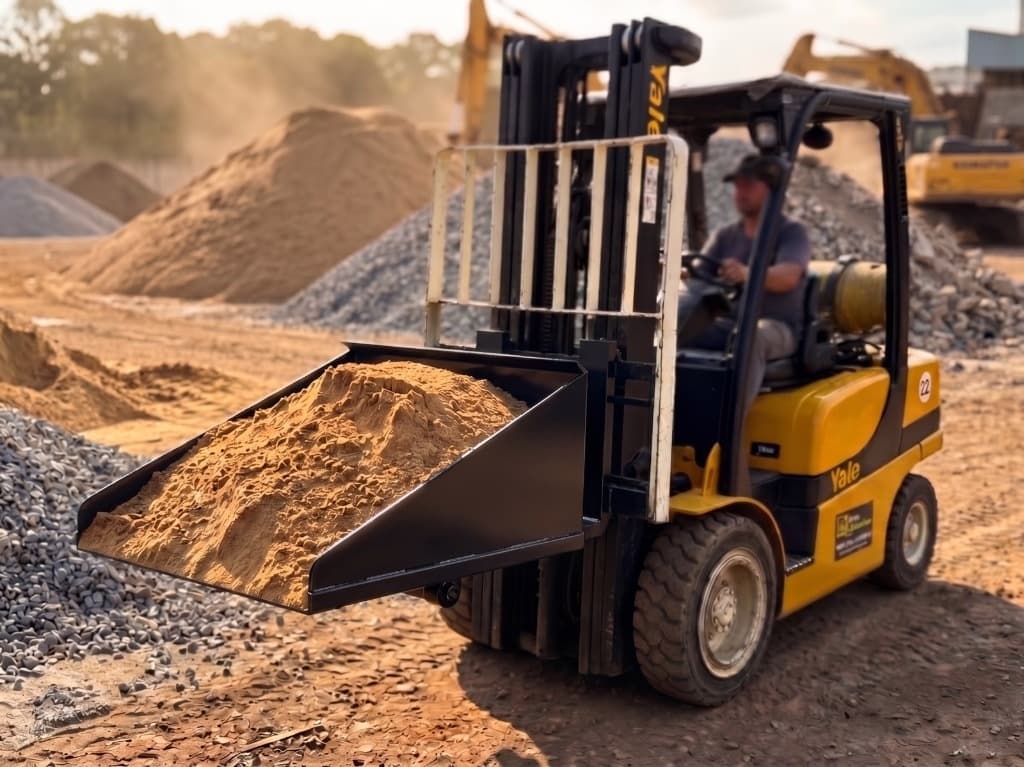
Anyone with a forklift who needs to move sand, gravel, grain, feed or rubble knows forks are no good for bulk materials. The FK-0250 Hydraulic Bucket clips onto the forks and uses the machine's auxiliary valve to drive a double-acting cylinder that tips the bucket through up to 65°.
Nominal data are 250 liters of volume and a load of up to 1,000 kg. But which of the two limits really applies in practice? The answer depends on material density.
2. Mass per Scoop: Volume Rules
The mass the bucket holds is volume times bulk density (the density of the loose material, voids between particles included). For 250 liters (0.25 m³), typical reference values are:
Approximate Mass in a Full Bucket (0.25 m³)
Reference values that vary with moisture, compaction and grading. Confirm your material's density.

3. The Real Limit: Volume, Rated Load or Truck?
To reach 1,000 kg in 250 liters, the material would need a density of 4,000 kg/m³, far above any ordinary sand, gravel or rubble. For the vast majority of materials the bucket fills (volume limit) long before reaching the attachment's rated load.
The limit that tends to matter is the forklift's. The bucket moves the load's center of gravity ahead of the fork face. The same tipping-moment reasoning applies: Q' ≈ Q · c₀ / c.
Verification Example (Illustrative)
4. 65° Dump Angle and the Angle of Repose
To empty completely, the bucket must tilt beyond the material's angle of repose, the angle at which loose material starts to slide over itself. Typical reference values:
The FK-0250's 65° dump comfortably exceeds values for dry materials and also covers cohesive ones, ensuring complete emptying without the operator having to hit or climb on the bucket.
5. Hydraulic Drive and Operating Safety
The FK-0250's double-acting cylinder connects directly to the forklift's auxiliary valve. That removes the need for its own hydraulic unit, but requires the machine to have the auxiliary circuit and hoses and fittings compatible with the valve's working pressure. The treated rod and high-performance seal reduce wear.
For safety, the bucket has a double fork lock against accidental slipping and a wear-resistant steel front blade. Under NR-11 and NR-12, the user must:
Productivity in Numbers
At 250 liters per scoop, each cubic meter of material takes 4 cycles. On a site moving 20 m³ a day, that is 80 scoops with no manual effort and no machine swap.
6. Technical Conclusion
The FK-0250 hydraulic bucket works as a wheel loader attached to the forklift. For almost all bulk materials, what limits the load is the 250-liter volume and the truck's stability, not the nominal 1,000 kg. Knowing the material density and checking residual capacity with the shifted center of gravity are the two calculations that ensure safe use.
To specify the ideal bucket for your material, talk to INCOFORK engineering.
Frequently Asked Questions (FAQ)
Engineering technical answers regarding kinematics, hydraulic circuits, NR-12/NR-10 safety and shop floor integration.
1Can the FK-0250 bucket really carry 1,000 kg?
The attachment's rated load is up to 1,000 kg, but its volume is 250 liters. To carry 1,000 kg, the material would need a density of 4,000 kg/m³, higher than sand, gravel or rubble. In practice volume limits first.
2How much does a scoop of sand weigh?
About 375 to 425 kg of dry sand and 450 to 500 kg of wet sand in a full bucket, using typical densities of 1,500 to 2,000 kg/m³. Confirm your material's density.
3Does any forklift work?
It needs an auxiliary hydraulic circuit and enough residual capacity with the bucket installed, since it moves the center of gravity forward. Consult the forklift manufacturer and our engineering team.
4Why a 65° dump angle?
To exceed the angle of repose of materials, including wet and cohesive ones, ensuring the bucket empties completely.
References & Standards
- BRAZIL. Ministry of Labor and Employment. Regulatory Standard No. 11 (NR-11): Transport, Movement, Storage and Handling of Materials. Brasília: MTE.
- BRAZIL. Ministry of Labor and Employment. Regulatory Standard No. 12 (NR-12): Safety in Machinery and Equipment. Brasília: MTE.
- INTERNATIONAL ORGANIZATION FOR STANDARDIZATION. ISO 3691-1: Industrial trucks — Safety requirements and verification. Geneva: ISO.
- ASSOCIAÇÃO BRASILEIRA DE NORMAS TÉCNICAS. ABNT NBR ISO 4413: Hydraulic fluid power — General rules and safety requirements for systems and their components. Rio de Janeiro: ABNT.
- FAYED, M. E.; SKOCIR, T. Mechanical Conveyors: Selection and Operation. Lancaster: Technomic.
Related Equipment
FK-0250 Hydraulic Bucket
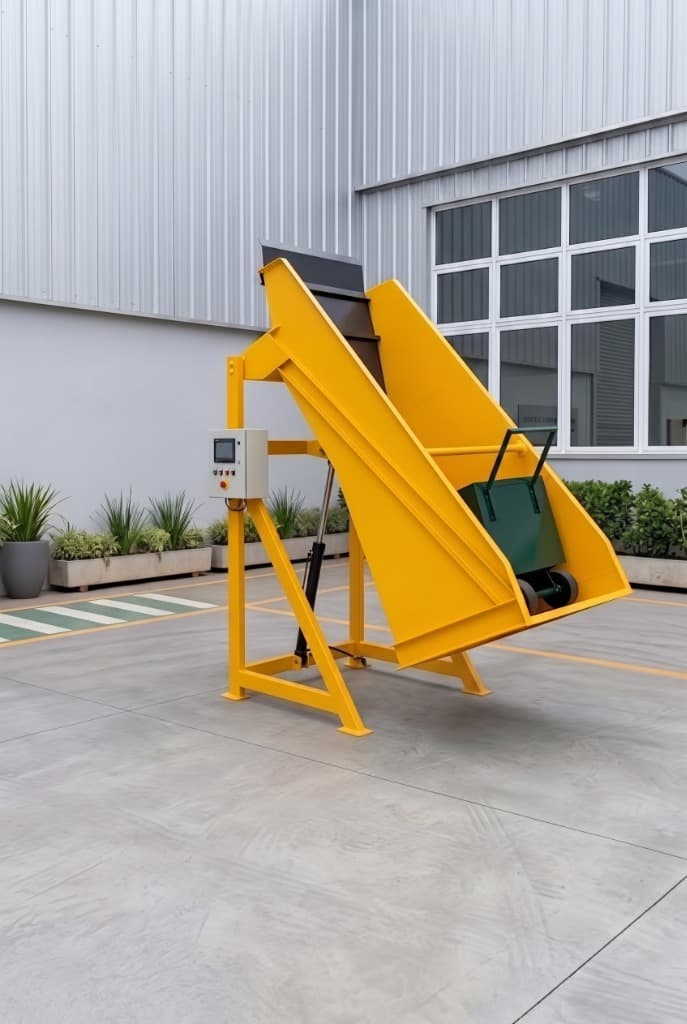
Autonomous station with 1.5 HP electro-hydraulic power unit, high-pressure cylinder (100 bar) with deceleration dampening via 3/8" valve, 135° tipping cradle, and full NR-10/NR-12 compliance.