
Forklifts & Attachments
Technical Analysis: Safety Factor, Sling Angle and Lifting Capacity of a 2-Ton Forklift Hook
How to read the WLL, the 4:1 safety factor and leg tension to lift safely with a fork-mounted hook beam.
Application & Hydraulic Engineering
INCOFORK Technical Department

Abstract
This study analyzes the use of a lifting hook fixed to a forklift's forks, with a rated working load limit (WLL) of 2,000 kg and a 4:1 safety factor. It defines WLL and breaking load, shows that a lifting assembly is only as strong as its weakest link, and quantifies how tension in sling and chain legs rises with the angle between them. It also covers the truck's stability limit and the NR-11 and NR-12 requirements for the operation.
Table of Contents
1. Introduction: Turning the Forklift into a Compact Crane
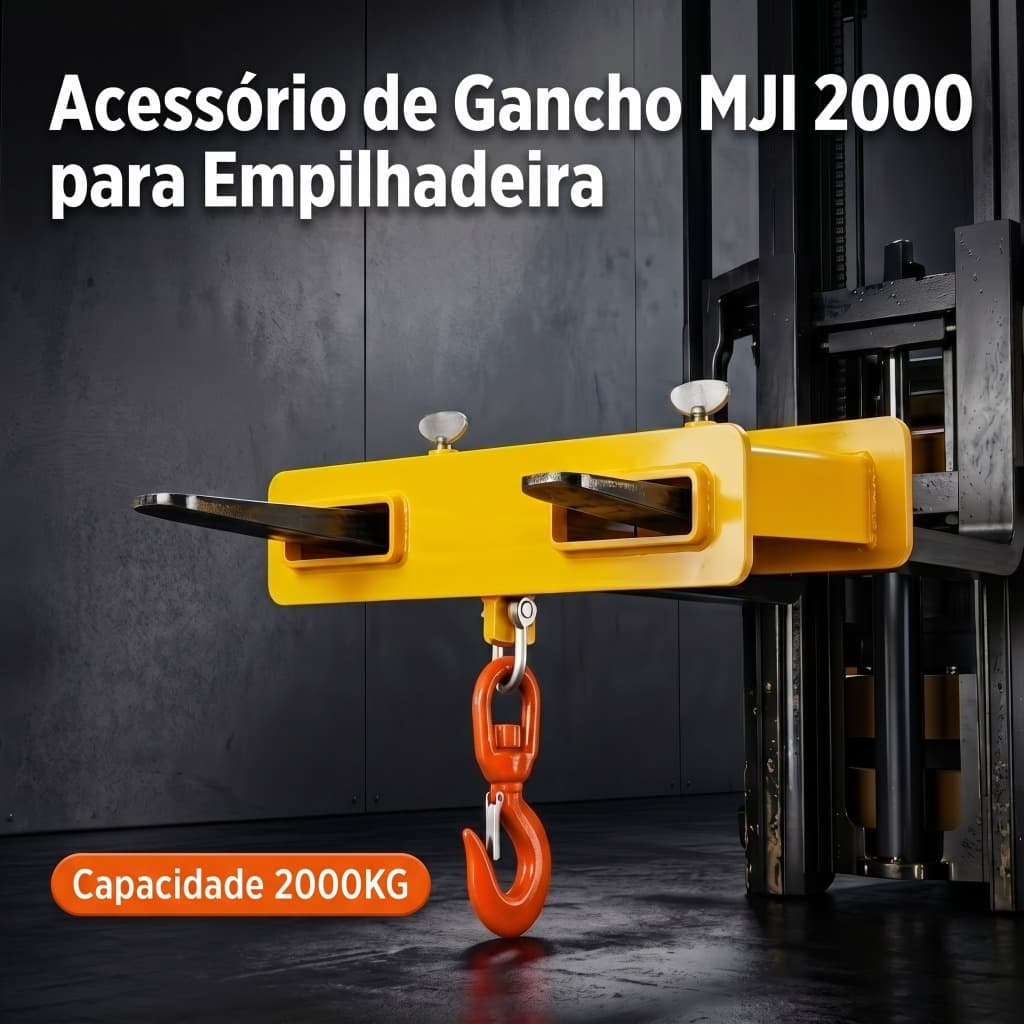
On job sites, in workshops and yards the forklift often has to lift loads without a pallet: steel structures, pipes, precast concrete blocks, plates, strapped coils, pumps and machines. The MJI-Hook 2000 meets that need with a structural beam that clamps to both forks with two top clamp knobs and an anchor chain, offering a swivel eye hook with latch for steel slings, textile slings or chains.
Rated capacity is 2,000 kg (2 tons) with a 4:1 safety factor. This study explains what those numbers mean and how to use the equipment without mixing up limits.
2. WLL, Breaking Load and Safety Factor
In lifting, the "working" capacity is called the WLL (Working Load Limit). It is the load the equipment may carry in normal use. The breaking load is the value at which the component fails. The ratio between the two is the safety factor.
What 4:1 Means
3. The Assembly Is as Strong as Its Weakest Link
The 2,000 kg WLL applies to the hook. The real lifting capacity is the lowest among all elements in the chain:
Before each lift, check the WLL of every element. Textile slings, for example, have a WLL that varies with the hitch type (straight, choker or basket), and steel chains and slings must carry legible identification.
4. Sling Angle Multiplies Tension
When the load hangs from two slings in a V, each leg carries more than half the weight, and the difference grows as the angle opens. With the angle θ measured from the vertical, the tension in each leg is T = W / (2 · cos θ).
Tension per Leg for a 2,000 kg Load
At 60°, each leg carries the full load, and the sling WLL must be sized for it. Avoid wide angles: keep the legs as close to vertical as possible.
5. Truck Limit and Applicable Standards
Even if the hook holds 2,000 kg, the truck may not. The lift point sits away from the fork face, and residual capacity follows the same moment rule: Q' ≈ Q · c₀ / c. For example, on a 2,500 kg truck at 500 mm with the hook 600 mm from the fork face, capacity drops to about 2,080 kg, and the beam's weight must still be deducted.
NR-11 requires capacity marking and operation by qualified workers, and NR-12 covers machine and attachment safety conditions. In practice:
Suspended Loads Swing
A hanging load oscillates like a pendulum, and the oscillation dynamically shifts the center of gravity. Braking or accelerating with the load raised can exceed the tipping limit even with a weight below the WLL.
6. Technical Conclusion
The MJI-Hook 2000 offers a 2,000 kg WLL with a 4:1 safety factor, but safe lifting depends on the whole chain: truck, beam, shackle, sling and leg angle. Respecting the weakest link and avoiding wide angles is what separates a safe operation from an accident.
To specify the right hook and accessories for your fleet, talk to INCOFORK engineering.
Frequently Asked Questions (FAQ)
Engineering technical answers regarding kinematics, hydraulic circuits, NR-12/NR-10 safety and shop floor integration.
1What does WLL mean?
WLL stands for Working Load Limit. It is the maximum load the equipment may carry in normal use, well below its breaking load.
2Can I lift 2,000 kg with any forklift using the MJI-Hook 2000?
No. The hook WLL is 2,000 kg, but the forklift must have enough residual capacity at the lift point reach. The final capacity is always the lowest value in the chain.
3Why does sling angle matter so much?
Because tension in each leg grows as the angle opens. With legs at 60° from vertical, each carries the full load. The sling WLL must therefore be chosen for the real angle of use.
4What are the two top clamp knobs for?
They tighten the beam onto the forks and, together with the anchor chain, keep the hook from slipping during handling.
References & Standards
- BRAZIL. Ministry of Labor and Employment. Regulatory Standard No. 11 (NR-11): Transport, Movement, Storage and Handling of Materials. Brasília: MTE.
- BRAZIL. Ministry of Labor and Employment. Regulatory Standard No. 12 (NR-12): Safety in Machinery and Equipment. Brasília: MTE.
- INTERNATIONAL ORGANIZATION FOR STANDARDIZATION. ISO 3691-1: Industrial trucks — Safety requirements and verification. Geneva: ISO.
- AMERICAN SOCIETY OF MECHANICAL ENGINEERS. ASME B30.9: Slings. New York: ASME.
- BEER, F. P.; JOHNSTON JR., E. R. Vector Mechanics for Engineers: Statics. New York: McGraw-Hill.
Related Equipment
MJI-Hook 2000 Forklift Hook Beam
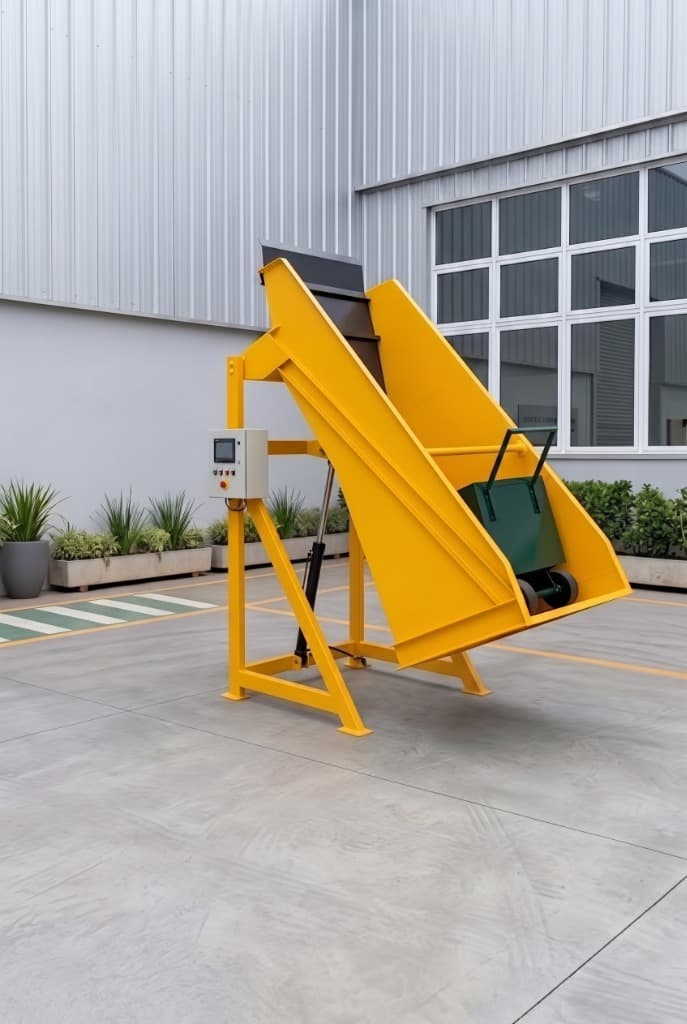
Autonomous station with 1.5 HP electro-hydraulic power unit, high-pressure cylinder (100 bar) with deceleration dampening via 3/8" valve, 135° tipping cradle, and full NR-10/NR-12 compliance.