
Forklifts & Attachments
Technical Analysis: Load Center, Residual Capacity Loss and Safety When Using Forklift Fork Extensions
How shifting the load center reduces a forklift's rated capacity, and what engineering demands to move long loads with full support.
Application & Hydraulic Engineering
INCOFORK Technical Department
Abstract
This study analyzes the effect of a fork extension on the longitudinal balance of a forklift. It starts from the tipping moment principle and the capacity plate (rated load at a reference load center, usually 500 mm) to quantify how residual capacity falls as load length grows. The box-section geometry, distributed support instead of a load hanging off the fork tip, pin-lock retention, and the requirements of NR-11, NR-12 and the applicable ISO standards for forks and trucks are discussed. The conclusion: the extension is a safe, economical solution when capacity is recalculated and the truck plate is respected.
Table of Contents
1. Introduction: The Problem of Long and Deep Loads
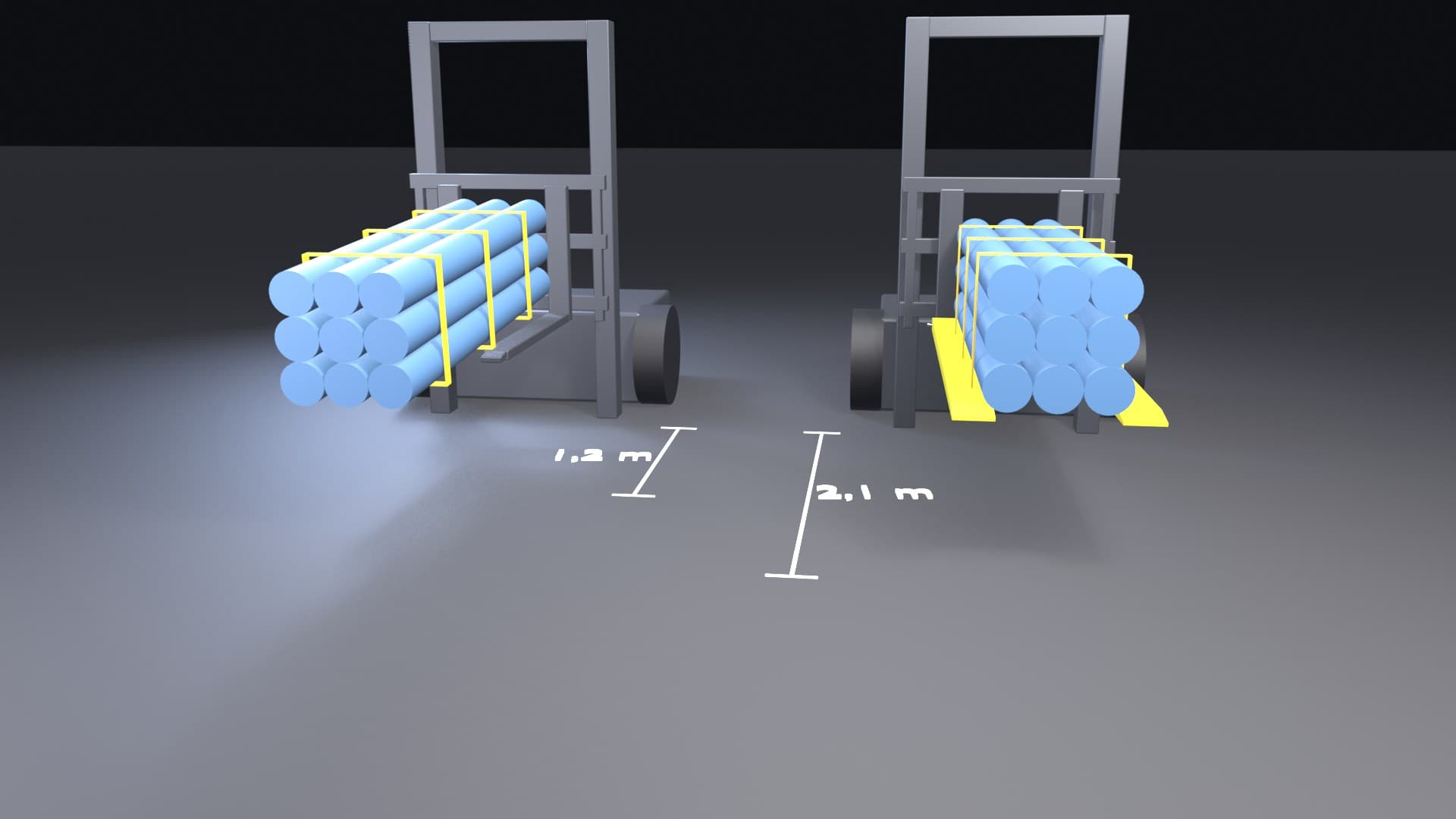
Pipes, profiles, bars, coils, rolls and very deep pallets share one trait: the load is longer than standard forks, which are typically 1,000 to 1,200 mm. When the operator tries to carry such a load, it ends up "hanging" off the fork tips, with the support point far from the center of gravity. The result is excessive fork bending, an unstable load and, at the limit, the truck tipping over.
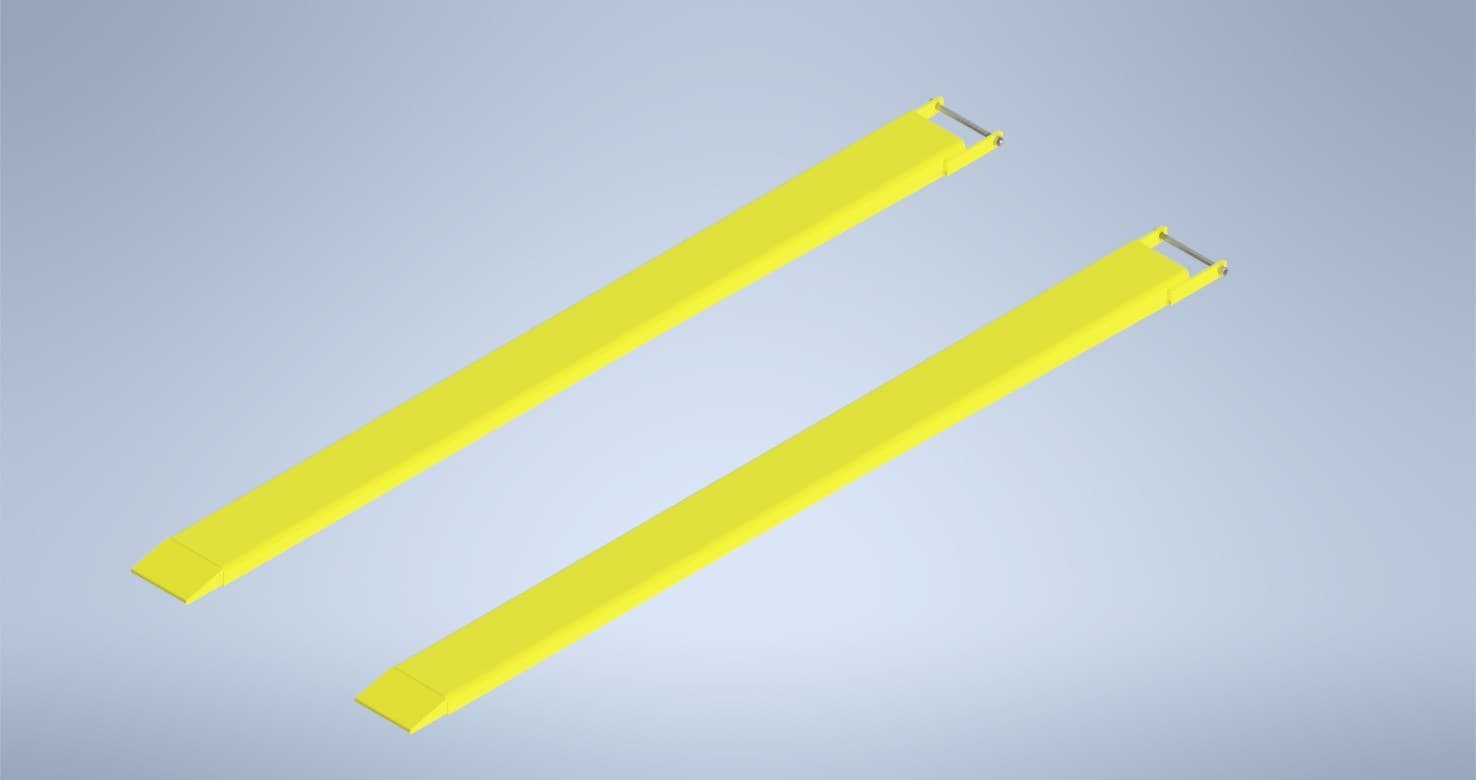
The traditional alternative is changing machines or forks, which costs time and money. The INCOFORK Fork Extension solves it differently: a pair of 2,100 mm extensions that slide over the existing fork and are locked by a pin, with no welding and no drilling of the original part.
Using basic forklift mechanics, this study shows why the extension improves load support, but also why it reduces the machine's rated capacity, and how to calculate that effect before use.
Warning
Every fork extension moves the load center forward and reduces the forklift's residual capacity. The original capacity plate is no longer valid without recalculation.
2. Load Center and the Logic of the Capacity Plate
A forklift's capacity plate gives the rated load Q at a reference load center c₀, measured from the vertical face of the fork to the load's center of gravity. On mid-size trucks the most common value is c₀ = 500 mm.
The manufacturer sizes the machine so that the load's tipping moment about the front axle (the pivot) never exceeds the stabilizing moment of the counterweight and chassis. Capacity is therefore not a fixed number: it depends on how far the load sits from the axle.
With an extension installed, the load can rest along up to 2,100 mm. For a uniform load supported along the whole extension, the center of gravity is at half the supported length, well beyond the 500 mm reference.
Residual Capacity from Moment Balance
3. How Much Is Lost: Residual Capacity by Load Length
For a long, uniform load resting on the whole extension, the actual load center is half the load length. Applying the relation above to a 2,500 kg truck at 500 mm gives the table below.
Estimate for a 2,500 kg Truck @ 500 mm
In practice: doubling load length from 1,000 to 2,000 mm halves the capacity. Also subtract the extensions' own weight.
4. Box-Section Geometry and Pin Retention
The INCOFORK extension is a welded box section, 154 x 66 mm outside, with a 130 x 55 mm inner entry opening that fits over the fork. The top plate (the one carrying the load) is 6.35 or 4.96 mm, and the bottom plate 4.96 or 3.18 mm.
From a strength-of-materials standpoint the box is advantageous: a hollow section has a high moment of inertia for its mass, giving bending stiffness without excess weight. Counting only the shell (ignoring the fork inside, which is conservative), the section has a moment of inertia of about 1.9 x 10⁶ mm⁴ and a section modulus of roughly 57 cm³ in the vertical direction.
Three more design points deserve mention:
5. Standards Compliance and Operating Practice
In Brazil, forklift operation is governed by NR-11 (transport, handling, storage and materials handling), which requires the maximum capacity to be shown in a visible place and the operator to be trained and qualified. NR-12 covers machine guarding and modifications that alter safety conditions. Internationally, ISO 3691-1 sets industrial truck safety requirements and ISO 2330 specifies fork arms.
In practice, we recommend:
Extension Capacity
The INCOFORK extension capacity is provided on request because it depends on the truck's fork model and section and on the load carried. The final working capacity is always the lower of the extension's and the truck's residual capacity.
6. Technical Conclusion
The fork extension is a simple, effective engineering solution for long loads: it provides full support, prevents tip bending and removes the need for a second machine. The price of that advantage is reduced residual capacity, which must be calculated from the tipping moment and confirmed with the truck manufacturer.
The INCOFORK Fork Extension was designed with a box section, chamfered tip and pin retention to meet that logic. To define the ideal pair for your truck and load, talk to our engineers.
Frequently Asked Questions (FAQ)
Engineering technical answers regarding kinematics, hydraulic circuits, NR-12/NR-10 safety and shop floor integration.
1Does the extension reduce my forklift's capacity?
Yes. Moving the load center forward raises the tipping moment for the same weight. Residual capacity falls roughly in proportion to c₀/c. On a 2,500 kg truck at 500 mm, a 2,000 mm long load reduces capacity to about 1,250 kg, before subtracting the extensions' weight.
2Does the extension require welding or drilling the fork?
No. It slides over the fork and is locked by a pin at the entry mouth. This preserves the structural integrity of the original fork, which must not be welded or drilled.
3Can I use the extension on any forklift?
The 130 x 55 mm inner opening suits forks of compatible section. Suitability depends on the truck model and capacity and must be validated with the truck manufacturer. Contact our engineering team with your fork dimensions.
4Why is the tip only 35 mm high?
To slide easily under pallets, pipes and coils without lifting or shimming the load. The chamfered tip reduces entry friction and the risk of damaging the load.
References & Standards
- BRAZIL. Ministry of Labor and Employment. Regulatory Standard No. 11 (NR-11): Transport, Movement, Storage and Handling of Materials. Brasília: MTE.
- BRAZIL. Ministry of Labor and Employment. Regulatory Standard No. 12 (NR-12): Safety in Machinery and Equipment. Brasília: MTE.
- INTERNATIONAL ORGANIZATION FOR STANDARDIZATION. ISO 3691-1: Industrial trucks — Safety requirements and verification — Part 1: Self-propelled industrial trucks. Geneva: ISO.
- INTERNATIONAL ORGANIZATION FOR STANDARDIZATION. ISO 2330: Fork-lift trucks — Fork arms — Technical characteristics and testing. Geneva: ISO.
- GERE, J. M.; GOODNO, B. J. Mechanics of Materials. Boston: Cengage Learning.
Related Equipment
Forklift Fork Extensions (Pair)
Autonomous station with 1.5 HP electro-hydraulic power unit, high-pressure cylinder (100 bar) with deceleration dampening via 3/8" valve, 135° tipping cradle, and full NR-10/NR-12 compliance.